Recent public discussion has focused on First Lady Melania Trump after renewed media attention and online commentary surrounding her past social associations. The topic resurfaced following ongoing public interest in historical figures connected to high-profile social circles in New York and Palm Beach, which has frequently been the subject of speculation across media platforms. In a recent public-facing statement, Melania Trump addressed these discussions directly, emphasizing that many of the claims circulating online have been misrepresented or exaggerated over time.
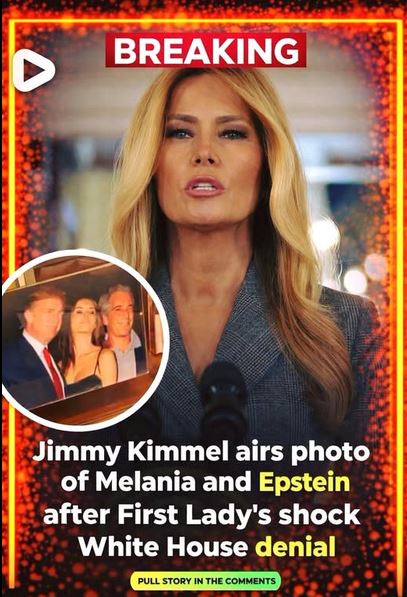
Her position, as communicated through public channels, was that narratives linking her to controversial figures have often been repeated without clear evidence or context, contributing to ongoing misunderstanding in digital spaces. According to her response, she rejected the idea that casual or incidental social encounters should be interpreted as meaningful personal relationships.
She highlighted that individuals in prominent social and business environments often appear in the same public settings without implying deeper personal connections. This distinction formed a key part of her effort to clarify her public image.
The discussion gained further momentum when commentary from media and entertainment platforms revisited historical photographs and public appearances involving various high-profile individuals. These discussions were largely driven by social media circulation and late-night television commentary, which often reinterpret past images for contemporary audiences.
One widely circulated segment from a late-night talk show added further visibility to the conversation by referencing previously known photographs from public events. The host’s commentary used satire and critique, a common format in entertainment media, to question how public figures are perceived and how historical associations are interpreted in hindsight.
This type of media framing contributed to increased online debate, with audiences divided between viewing the situation as a matter of public accountability and others seeing it as an example of how old images can be reinterpreted outside of their original context. As with many politically charged topics, social media amplified contrasting interpretations rapidly.
During the same period, additional commentary suggested that communication between public figures and their surrounding networks can sometimes be inconsistent when responding to fast-moving media narratives. These observations were largely speculative in nature and reflect broader discussions about how political families manage public relations in the digital era.